
Nasa Flight Programs
INTERNATION SPACE STATION EXPERIMENTS
UCCS students have the opportunity to fly an experiment aboard the International Space Station (ISS) each year. This opportunity is part of an extremely selective international program, with fewer than 25 student-designed experiments selected globally each year. UCCS has already proven itself as a top-tier contender in this area. Our previous ISS flight experiment “Calcium Sulfate Crystal Growth in Microgravity“ not only generated meaningful scientific results; it also brought much media attention and community excitement to our campus. A second mission, “Fungal Bioleaching in Microgravity,” is already scheduled to launch in Spring 2026.
This program is far more than another student project; it’s an opportunity to market the College of Engineering and Applied Science on a national stage. Each mission elevates UCCS’s profile as a hub for undergraduate research and innovation, and the benefits are lasting:
- High-impact student engagement in aerospace, biotechnology, and engineering—fields essential to Colorado Springs’ economy.
- Unmatched undergraduate research experiences that shape careers and boost graduate school and job placement.
- Consistent, widespread media coverage that highlights UCCS’s leadership in student-driven space exploration.
- And most importantly: a powerful recruitment tool. Programs like this draw attention from prospective students across the country, showcasing the hands-on, high-profile opportunities that set EAS apart.
Recent visibility includes features by KRDO, KOAA, Fox21, KRCC, The Gazette, and multiple articles in the UCCS Communique and The Scribe. Projects like ours—focusing on cutting-edge topics such as fungi in microgravity and sustainable agriculture in space—are rare nationally, and they position EAS as a program that delivers on bold, real-world learning.
Recent articles about UCCS’ ISS experiments.
May 20, 2025 KRDO News 13 Morning Show
Space mold! UCCS and Pikes Peak State College students sending experiment to space | KRDO
KOAA News 5. (2024, May 15). Three students will have their science experiment flown in space on the ISS. KOAA News 5. https://www.koaa.com/news/covering-colorado/three-students-will-have-their-science-experiment-flown-in-space-on-the-iss
May 12, 2025 UCCS Scribe
UCCS students to send an experiment to space – The Scribe
February 12, 2025 UCCS Communique
Mushroom in space! UCCS and PPSC multi-disciplinary student team sends new experiment to space
Carr, K. (2024, November 26). UCCS and Pikes Peak State College Students’ experiment orbits on the International Space Station. Colorado Public Radio. https://www.cpr.org/2024/11/26/uccs-ppsc-student-experiment-international-space-station/
From campus to space: UCCS students launch experiment to the ISS – UCCS communique. (2024, November 11). https://communique.uccs.edu/?p=160064
November 2, 2024, Gazette
Colorado Springs college experiment to launch to ISS | Education | gazette.com
October 25, 2024 Fox 21 News
Local students to send experiment into space | FOX21 News Colorado
UCCS students prepare experiment for International Space Station Flight – UCCS Communique. (2024, October 30). https://communique.uccs.edu/?p=159680
November 11, 2024 UCCS Communique
From Campus to Space: UCCS students launch experiment to the ISS – UCCS Communique
May 14, 2024 KOAA News
Three students will have their science experiment flown in space on the ISS
Blake MacDonald, Noah Grebe, and Luke Davis are hoping to learn more about effective low-cost fertilizers that could grow food on other planets.
April 24, 2024 UC News
VIDEOS
ISS Launch Highlights. (2024, November 13). ISS Launch Highlight (1.5min) on Vimeo
NASA’s ROCKSAT SOUNDING ROCKET PROGRAM
Funding Crickets in Space: Tackling a Big Question with a Tiny Payload (2025, May 21). https://news.uccs.edu/2025/05/21/crickets-in-space-tackling-big-questions-with-a-tiny-payload/
NASA RASC-AL COMPETITION
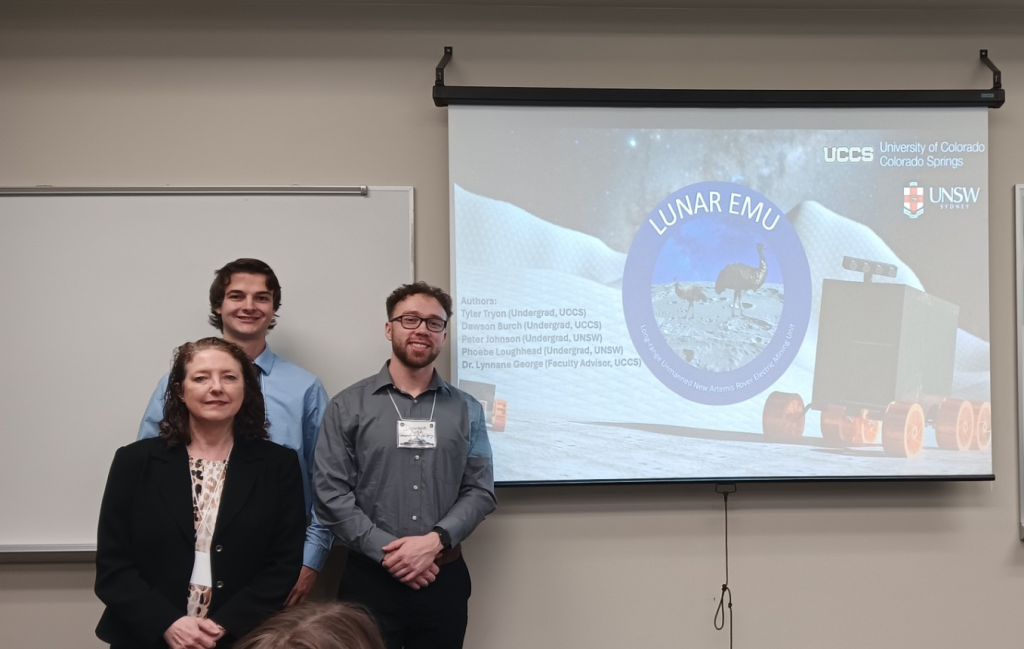
Long-range Unmanned New Artemis Rover Electric Mining Unit (LUNAR EMU) 2024
The UCCS NASA RASC-AL senior design team worked in collaboration with the University of New South Wales (UNSW) from Sydney, Australia, to create LUNAR EMU, a dual rover architecture created to find and analyze substances in the south lunar craters to help bring a sustained human presence to the NASA Artemis missions. Conforming to NASA and self created guidelines and requirements, LUNAR EMU can travel 464.8km on hydrogen fuel cell technology with an operating lifetime cost of $212.6 million, ready to launch by August of 2032 due to its high technical readiness level (TRL). If it travelled at the same speed of an average Martian rover, it can travel continuously for 56 years. It has an array of scientific equipment from cameras to mass spectrometery to identify the materials of interest, and the dual rover architecture allows it to explore two areas of interest at once making it an efficient exploration vehicle.
George, L. and J. Lonsky (2023) A Multi-Use Resupply Platform at L1. AIAA Ascend Conference, Las Vegas, NV 23 – 25 Oct 2023. https://arc.aiaa.org/doi/10.2514/6.2023-4657