
Research Projects
1. Extensions to QTAIM – Development of Gradient Bundle Analysis
We use the quantum theory of atoms in molecules (QTAIM) to study reactivity in a variety of systems as well as extending this theory. Current work focuses on catalysis design methods incorporating electric fields.
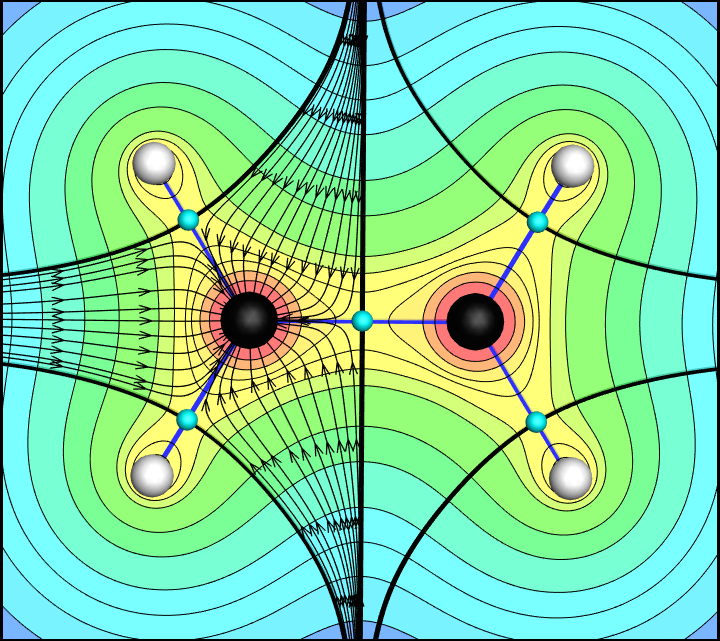
Gradient paths in a carbon atomic basin of ethene superimposed on a contour plot of the charge density. The gradient bundles bounded by these paths can be integrated over to determine volume, energy, and electron count. Electric fields shift the positions of gradient paths, which changes regions most likely to undergo reaction.
- N. Hughes, C. Morgenstern, A. Morgenstern. Understanding the effects of electric fields on molecules through gradient path curvature. Struct. Chem. 2025 https://doi.org/10.1007/s11224-025-02656-7
- L. Epperson, M. Mascarenas, A. Morgenstern. Gradient Bundle Analysis of Electric Field Induced Changes in Electron Charge Density. J. Phys. Chem. A. 2023, 127 (21) 4682-4694.
- A. Morgenstern, T. Wilson, J. Miorelli, T. Jones, M. E. Eberhart. In search of an intrinsic chemical bond. Comput. Theor. Chem. 2015, 1053, 31-37.
2. Understanding and Designing Enzymes through Electric Fields
Our group studies enzymes in terms of understanding and designing novel enzymes. This work focuses on finding descriptors in reactant state charge densities that correlate with electric fields in active site and activation barriers. Long-term, the goal is to use these methods to accelerate enzyme design.
Active site of Kemp eliminase with catalytic electric field direction shown. Current work stdies how critical points and molecular orbitals in the reactant state are perturbed by electric fields to alter reaction rates.

- H. Redmon, K. H. Ly, J. Mulcahey, A. Morgenstern. Predicting Activation Barriers with Ring and Bond Critical Points in Kemp Elimination Reaction. Submitted May 2026.
- T. R. Wilson, A. Morgenstern, A. N. Alexandrova, M. E. Eberhart. Bond bundle analysis of ketosteroid isomerase. J. Phys. Chem. B. 2022, 126, 9443-9456.
- A. Morgenstern, M. Jaszai, M. E. Eberhart, A. N. Alexandrova. Quantified electrostatic preorganization in enzymes using the geometry of the electron charge density. Chem. Sci 2017, 8 (7), 5010-5018.
- C. Valdez, A. Morgenstern, M. E. Eberhart, A. N. Alexandrova. Predictive methods for compu- tational metalloenzyme redesign – A test case with carboxypeptidase A. Phys. Chem. Chem. Phys. 2016, 18 (46), 31744-31756.
- M. R. Nechay, N. M. Gallup, A. Morgenstern, Q. A. Smith, M. E. Eberhart, A. N. Alexandrova. Histone deacetylase 8: Characterization of physiological divalent metal catalysis. J. Phys. Chem. B. 2016, 120 (26), 5884-5895.
3. Electrospray ionization (ESI) microdroplet reactions
This is the newest project in the Morgenstern group and is a collaboration with Dr. Janel Owens. We are running DFT calculations to understand the mechanisms that occur during microdroplet reactions in ESI for tetramine and related compounds during certain experimental set-ups.
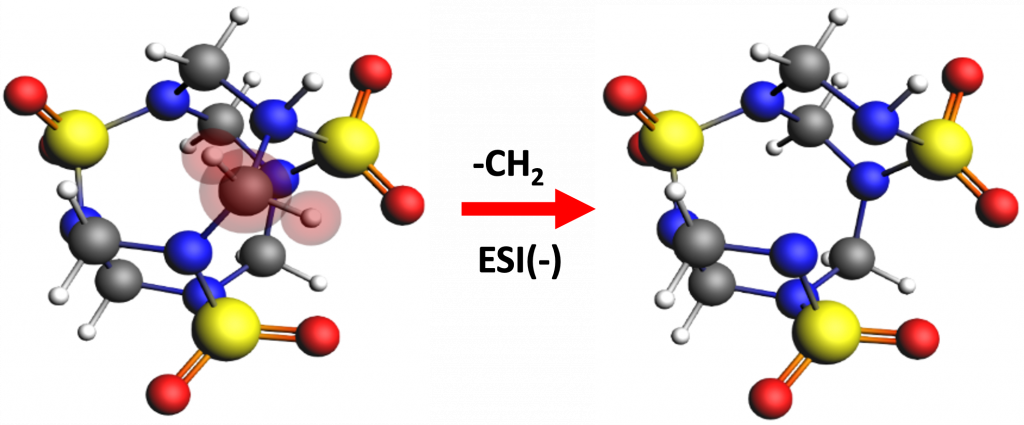
One unusual in source fragmentation phenomenon occurs during ESI for tetramine. This cage structure dimerizes with acid and heat (molecule shown at the left) and has been found to undergo a ring-opening reaction with subsequent loss of an entire methylene group during ESI.
- J. Gertner, J. Cook, B. Mayer, J. Owens, A. Morgenstern. DFT and Mass Spectrometry Study of (–)ESI-Induced Fragmentation of the Highly Toxic Rodenticide Tetramethylenedisulfotetramine. ACS Omega. 2026, 10.1021/acsomega.6c00837.
- J. Owens, S. Hok, A. Alcaraz, C. Koester. Quantitative Analysis of Tetramethylenedisulfotetramine (Tetramine) Spiked into Beverages by Liquid Chromatography−Tandem Mass Spectrometry with Validation by Gas Chromatography−Mass Spectrometry. J. Agric. Food Chem. 2009, 57 (10), 4058-4067.